Eritrea · 1961 — and the flame still burns

Land of the Martyrs
Flame of the Revolution

Thirty years of armed struggle watered the mountains and valleys of Eritrea with the blood of its heroes, until the chains broke and the flag rose. These pages are a tribute to those who went before, a testimony to what is happening now, and a hand stretched out to those who remain.

Page one · The duty

Glory and everlasting life to our righteous martyrs

From the first spark at Adal in 1961 to the liberation of Asmara in 1991, the Eritrean people gave wave after wave of martyrs: fighters and civilians, men and women, youths in the springtime of their lives. They did not die so that the nation could be ruled by fear; they died so that its children might live free and generous.

0years of armed struggle
0martyrs on the road to liberation
0the year the land was freed
"Whoever dies defending his land and the dignity of his people has not died — he is born again in the heart of every free person."

The wall of light — we lit these candles for every home that injustice extinguished, and every flame says the same thing: we will not forget

Page two · The truth

When the executioner turned on his people's revolution

Eritreans carried weapons for thirty years against the occupier — and the chains came back, this time in the hands of yesterday's comrades. Since 1991 Isaias Afwerki has ruled the country with no constitution, no elections and no press, until the land of the martyrs is described by many as an open-air prison.

01

A constitution in a drawer
The draft constitution was approved in 1997 and is still ink on paper: no separation of powers, no guarantee of freedoms, no ceiling on the authority of one man.

Read the article
02

No elections.. ever

Since independence in 1993 Eritrea has not seen a single national election; Afwerki has ruled without a mandate from the ballot box for more than three decades.

Read the article
03

National service without end

Open-ended forced conscription that a UN Commission of Inquiry described as amounting to enslavement; a whole generation withering in camps and forced labour.

Read the article
04

The graveyard of the press

On 18 September 2001 every independent newspaper was closed and its journalists arrested; for years Eritrea has ranked last on the world press-freedom index, behind even North Korea.

Read the article
05

The G-15

In September 2001 veteran leaders and fighters who had called for reform and for the constitution to be applied were arrested; they vanished into secret prisons without trial, and the fate of many is still unknown.

Read the article
06

Prisons under the ground

Thousands of detainees with no charge and no judge, in bunkers dug beneath the earth and metal containers under the sun; torture, according to the United Nations and human-rights organisations, is a systematic practice.

Read the article
07

A people in exile

Hundreds of thousands have fled the homeland; for years Eritrea has been among the world's largest sources of refugees relative to its population, its youths risking the sea and the desert to escape lifelong service.

Read the article
08

The one-man state

No free internet, no independent universities, no parties, no unions.. a state run by one party and one man, and the people are the ones who pay.

Read the article
"Eritrean officials have committed crimes against humanity since 1991 that may include enslavement, imprisonment, enforced disappearance, torture and persecution" — UN Commission of Inquiry on Eritrea, 2016

Sources: UN Commission of Inquiry on Eritrea (2015–2016) · Human Rights Watch · Amnesty International · Reporters Without Borders

ErOpp files

Articles and testimony

Close readings of the tragedy of a homeland: dates and turning points written in blood and in silence.

Timeline · sixty years

From the spark at Adal.. to today

Sixty years between the first shot and the last deferred promise. Choose a year on the rail to jump to it — and every stop carries a link to its full file.

  1. 1961

    The spark of Adal

    On 1 September the armed revolution began with a single shot at Adal, opening thirty years of struggle against Ethiopian rule.

  2. 1991

    Liberation and the entry into Asmara

    After three generations of fighting, the Mengistu regime fell and the liberation movement entered Asmara. The people had given some 65,000 martyrs, and were promised a constitution within four years.

    Read: A constitution in a drawer
  3. 1993

    Independence by referendum

    A UN-supervised referendum in which Eritreans voted overwhelmingly for separation, and the world recognised Eritrea as an independent sovereign state.

    Read: No elections.. ever
  4. 1995

    The national service proclamation

    National service was enacted for eighteen months: one year of training and one year of building. No one imagined it would swallow a whole lifetime.

    Read: National service without end
  5. 1997

    A constitution ratified but never applied

    A constituent assembly ratified a constitution drafted through popular consultation since 1994: party pluralism, separation of powers, periodic elections. Not one of its articles has ever been implemented.

    Read: The homeland never allowed to be born
  6. 1998–2000

    The border war with Ethiopia

    A war that cost tens of thousands of lives on both sides, returned the country to a state of emergency, and supplied the eternal pretext for postponing the constitution.

  7. 2001

    18 September.. the day the word was silenced

    The arrest of the G-15 from inside the ruling structure, the closure of every independent newspaper in a single night, and the expulsion of foreign journalists. It is precisely here that the Eritrean spring ended.

    Read: The G-15 Read: The graveyard of the press
  8. 2015

    The peak of the exodus

    The United Nations estimated that around five thousand Eritreans were leaving each month from a country of no more than six million people — one of the highest refugee rates in the world.

    Read: A people in exile
  9. 2016

    The UN Commission of Inquiry

    A commission of the Human Rights Council documented enslavement, enforced disappearance and systematic torture, and concluded that these acts may amount to crimes against humanity.

    Read: Prisons under the ground
  10. 2018

    Peace without opening

    A peace agreement with Ethiopia ended the state of war, but the promised opening inside Eritrea never came: no constitution, no elections, no prisoner released.

  11. 2020–2022

    The Tigray war

    Eritrean forces took part in the war inside Ethiopia; organisations documented abuses against civilians, while Eritrean youths continued to be marched to the front without end.

  12. Today

    A quarter century without a constitution

    Decades since the last promise of elections, national service is still open-ended, and journalists are still in prison. The problem is no longer individuals — it is an entire system.

    Read: The one-man state

Page three · Standing with us

Back the voice of truth

This platform is independent and run by volunteers. Your support helps us archive the stories of the martyrs, document abuses, translate reports and carry the voice of the oppressed to the world. Every contribution, however small, is a new flame in the wall of light.

Donations and support currently run through our Telegram channel; the platform's news and articles are published on Instagram, Facebook and TikTok.

ErOpp archive · twelve files

The files in full

Press any heading to read its file in full right here on the page — and share it if you see in it a testimony worth telling.

A constitution in a drawer
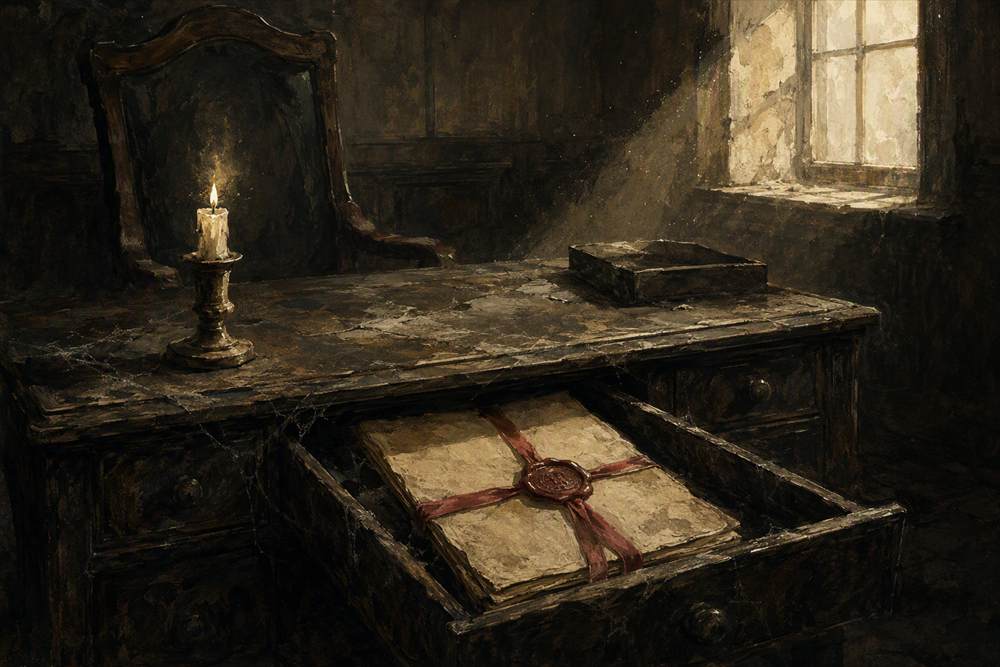
A red-ribboned sealed dossier left in the drawer of an abandoned government desk

After independence a constituent assembly was formed, and in 1994 a constitutional committee travelled through villages, towns and exile communities gathering people's proposals. The constitution was completed and ratified in May 1997: party pluralism, separation of powers, guaranteed freedoms, periodic elections.

Not one article of it was implemented. It was announced that the border war with Ethiopia (1998–2000) had "postponed" its promulgation, and then the postponement itself became the country's working constitution: no constitutional court to interpret, no independent judiciary to adjudicate, no parliament to legislate or hold to account.

The result is a rule based on one person's mood rather than on a written text: the National Council has not met regularly since 2001, and decisions of fate — from war to peace to the destiny of an entire generation — issue from a single office.

A people who paid thirty years of blood for a homeland ruled by law now find themselves ruled without law. That is why we say: returning the constitution to life is not a legal luxury, it is the first step on the road out.
No elections.. ever
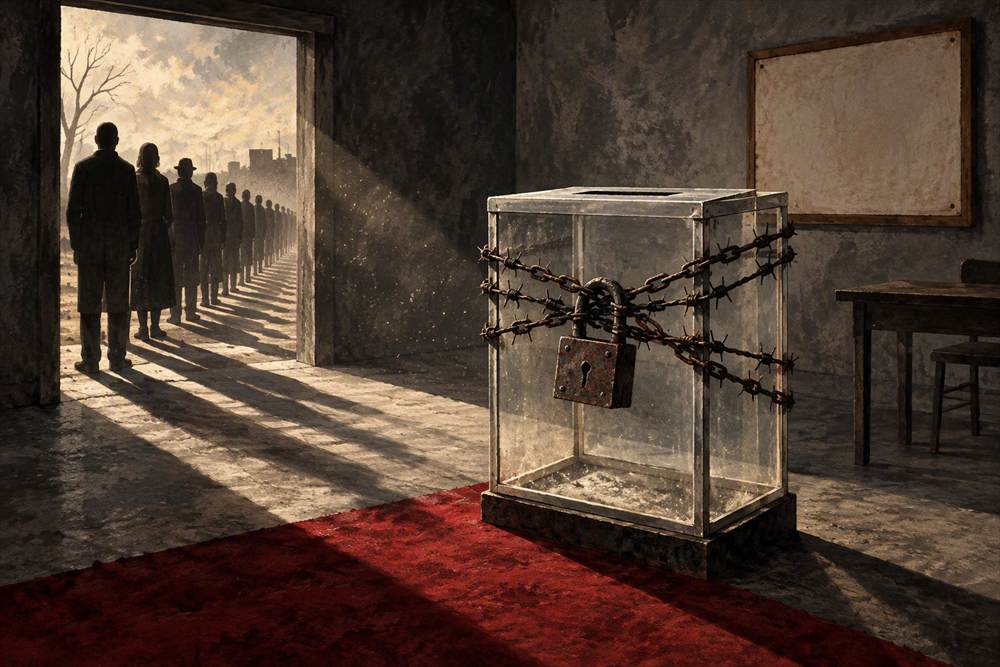
A glass ballot box locked with barbed wire while voters queue outside the door

Since independence was declared in 1993 Eritrea has known neither a presidential nor a parliamentary election. What took place was a limited transitional vote in 1993, then local elections in 2000 which were themselves cancelled, and the whole path was cut off.

What is striking is that the system itself adopted a constitution in 1997 that expressly provides for elections every five years and a term limit for the president. Isaias Afwerki has overridden that text for three full decades, remaining president without a renewed popular mandate for more than thirty years.

There is no opposition candidate waiting for a ballot box, because parties are effectively banned, the press is chained and public gathering is forbidden. Elections were not cancelled by an announced decision.. the entire country was emptied of the possibility of holding them.

And when a people vote with their feet, fleeing by the thousands every month, that is the clearest electoral statement in the world: a legitimacy that has lost every one of its ballot boxes and has nothing left but fear.

National service without end
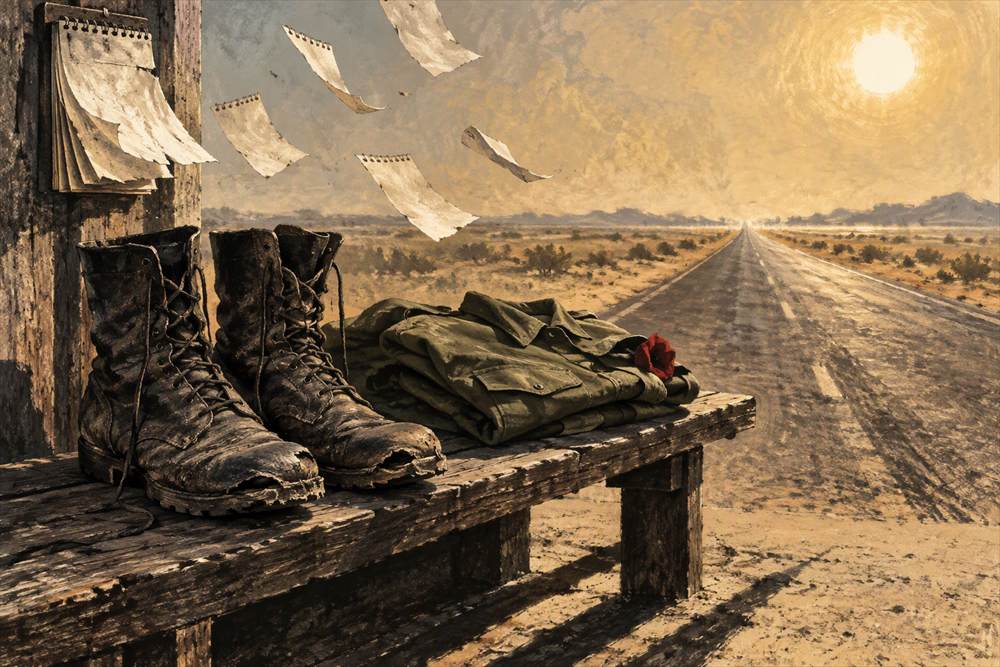
Worn-out military boots and a folded uniform beside a road that never ends

National service was enacted in 1995 for a fixed term of eighteen months: one year of training and one year contributing to construction. But the 1998 war opened the gates wide, and it turned into open-ended conscription with no end date, leaving an entire generation in the camps.

A student in the twelfth grade is marched to the Sawa camp, and from there to military units, state projects or army farms, on a symbolic wage that will not close a gap of hunger. Those who are late or absent are arrested, and neighbourhoods and markets are ringed in raids that people call "Giffa".

The United Nations Commission of Inquiry (2015–2016) concluded that this system amounts to enslavement, documenting open-ended forced labour under threat of prison and torture, and orders to shoot anyone attempting to cross the border.

This is how whole lifetimes are stolen in the name of duty: no years left for study, for marriage, for a dream. The homeland the young liberated has become a prison guarded by the young.. and the entire life is "service" that ends only in flight or in the grave.

The graveyard of the press
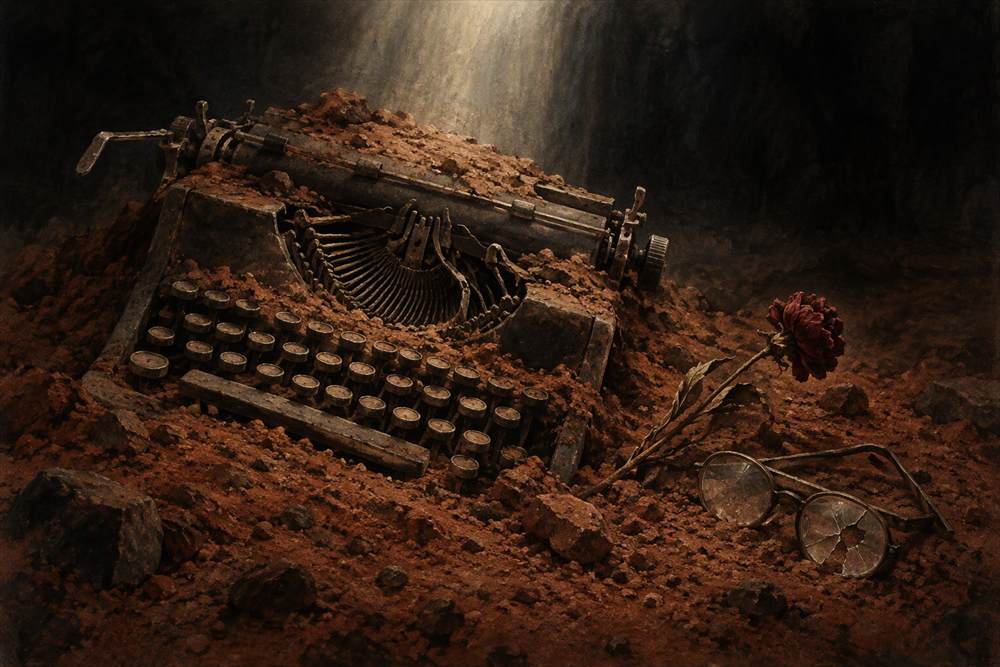
A typewriter buried in the dirt with broken spectacles and a withered flower

After liberation in 1991 Eritrea knew a relative media window: state newspapers alongside independent ones published in Tigrinya, Arabic and English, criticising ministers and local officials and opening files of corruption. That window lasted about ten years.

On 18 September 2001 all independent newspapers were closed at once — "Memitgnas", "Zemen", "Adaliss", "Setit" and others — and their publishers and editors arrested, while foreign journalists were barred from entering the country. Since that day there is not a single independent newspaper in Eritrea.

Rights organisations have recorded the death in custody of a number of journalists, and the Swedish-Eritrean journalist Dawit Isaak remains detained since 2001 without charge or trial, in one of the longest cases of journalist detention in the world.

Today Eritrea sits at the bottom of Reporters Without Borders' press-freedom index every year, sometimes ranked below North Korea itself. A country where the word is not permitted.. is a country run by silence.

The G-15
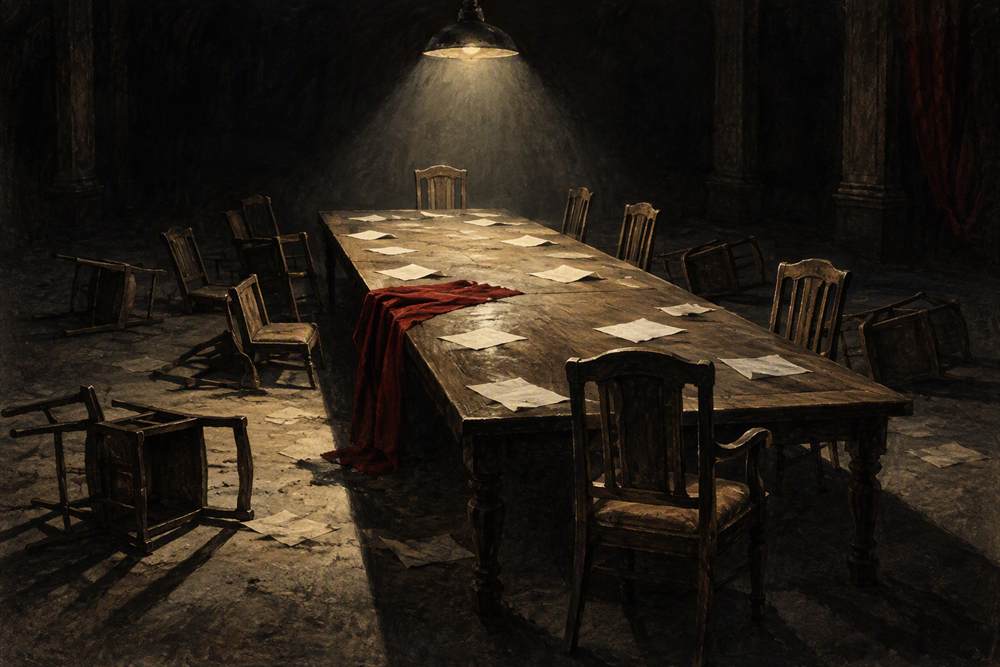
A long empty conference table with overturned chairs under one lamp

In the spring and summer of 2001, fifteen figures from the leadership of the state and the liberation movement — former ministers, field commanders and heroes of the first rank of the fighting, some of whom had fought beside Isaias Afwerki himself since 1961 — sent open letters demanding that the constitution be applied, freedoms released, and those negligent in the conduct of the 1998 war held to account.

The answer came at dawn on 18 September 2001: a wave of arrests took most of the signatories, who were moved to solitary cells and secret prisons, with no announced charge, no lawyer, no trial, and no news to their families of where they were held.

The fate of most of them remains officially unknown to this day. The government announced the death of Mohammed Said Nawud in custody in 2004 "from a heart attack", rights reports placed a number of others behind bars, and those who escaped were sentenced in absentia.

These men were not opposition from abroad; they were partners in the revolution and in power. And this is the truth the system flees: the most dangerous threat to one-man rule came from within it.. and its authors were buried in the desert.

Prisons under the ground
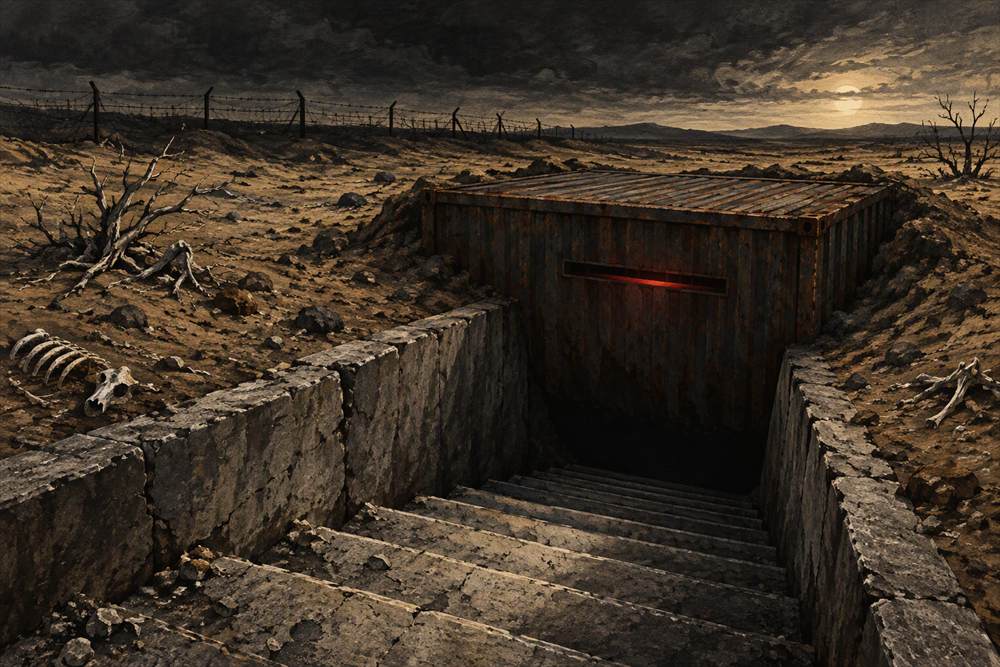
A shipping container half-buried in desert earth with concrete steps leading down

Eritrea keeps no public register of its prisoners and no judiciary that hears their cases. The security apparatus arrests and holds alone; most detainees never see a judge at all, and those who are brought before anyone face exceptional military courts that meet none of the minimum standards of a fair trial.

The UN Commission of Inquiry documented forms of detention that signal real danger: cells dug underground in Eiraeiro, Ouetal, Massawa and Asmara; metal containers that suffocate in summer and freeze in winter; and small rooms in which dozens are packed without bedding, ventilation or toilets.

As for torture, the Commission described it as a systematic practice rather than isolated incidents: severe beating, suspension from the ceiling for hours, sleep deprivation, and denial of medical treatment until death. It concluded that these acts may amount to crimes against humanity.

And most alarming of all, arrest reaches families: entire households are detained to pressure a son who fled national service, and fines are imposed on anyone who asks after the fate of a prisoner. In Eritrea a prison is not the destiny of the convicted.. it is an instrument of governance.

A people in exile
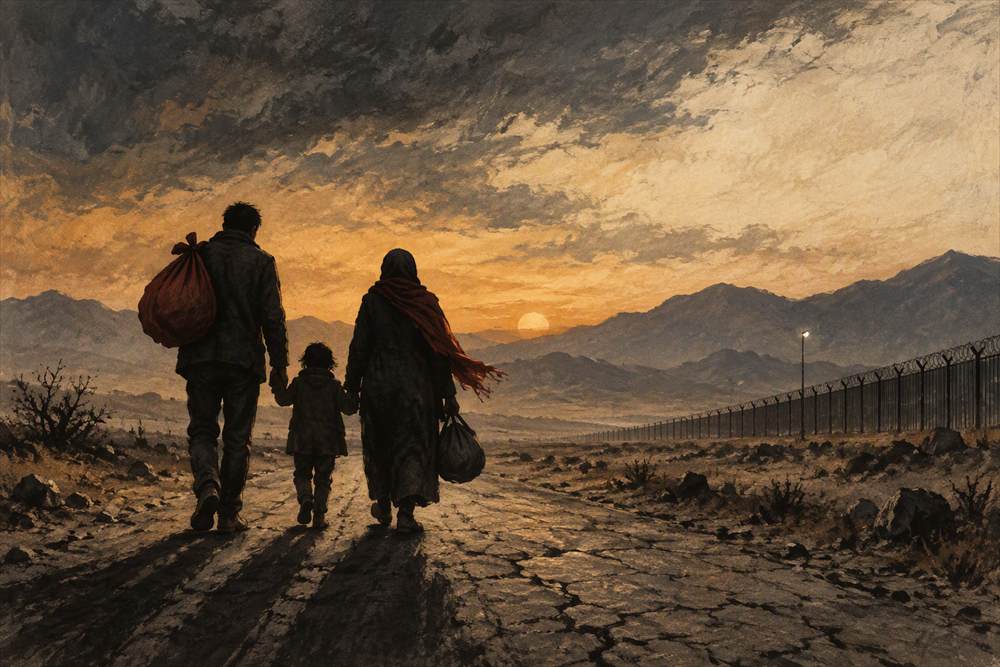
A family seen from behind walking a cracked road toward a border fence

Hundreds of thousands of Eritreans fled over the past two decades. In 2015 alone the United Nations estimated that around five thousand people were leaving each month from a country of no more than six million — a rate that made Eritrea one of the world's largest sources of refugees relative to population.

The nearest diaspora is Sudan and Ethiopia, where camps have hosted millions since 1998. But the deeper tragedy happens on the routes: the Sinai desert, where organisations recorded kidnappings and torture for ransom by traffickers who exploited the desperation of the fugitives, and then the boats of the Mediterranean that swallowed thousands.

And in exile the citizen does not escape the state's hand: the 2% "development" levy is collected on the income of those working abroad, and consular services — renewing passports, registering births, even burying the dead — are tied to paying it, a practice the UN Security Council condemned repeatedly.

The Eritrean people did not choose exile; they were pushed into it. Every drowning in the sea, every young man wasting at a crossing, is a silent bill of indictment against a quarter century of rule without a constitution. The homeland was not left.. it was temporarily expelled from, and it will return.

The one-man state
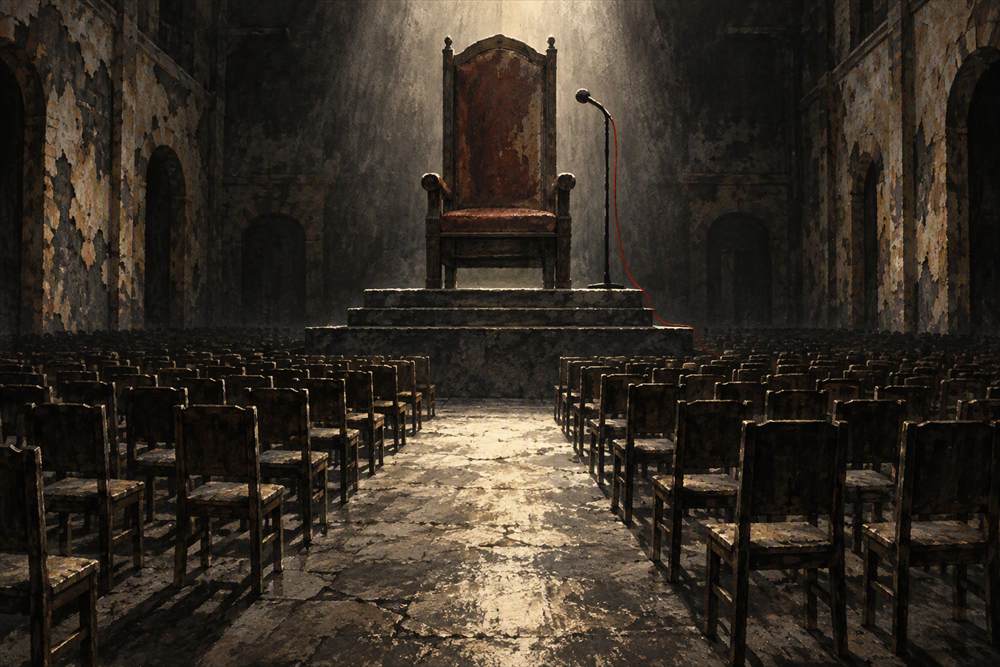
One enormous empty chair on a platform above rows of vacant seats

Isaias Afwerki has led Eritrea as president since 1993, and since 2001 every space of participation has been closed one after another: the People's Front for Democracy and Justice is the single dominant party, parliament is suspended, unions and associations are under guardianship, and public gathering is banned without security permission.

At the level of daily life: there is no free internet and no independent media, communications are subject to surveillance and inspection, universities oblige most of their students to national service, and the economy is dominated by the army, the party and projects answerable to no published budget and no oversight.

And at the top, one man who answers to no one: no constitution in force, no constitutional court, no elections, no press. Decisions of war, peace and famine are taken in a single room, and the people pay in their years, their blood and their livelihood.

That is why human-rights organisations and democratic forces insist that the problem is not individuals alone but an entire system, and that the solution is not replacing one man with another, but replacing one-man rule with the state of law and the constitution.

18 September 2001 — the day the word was silenced
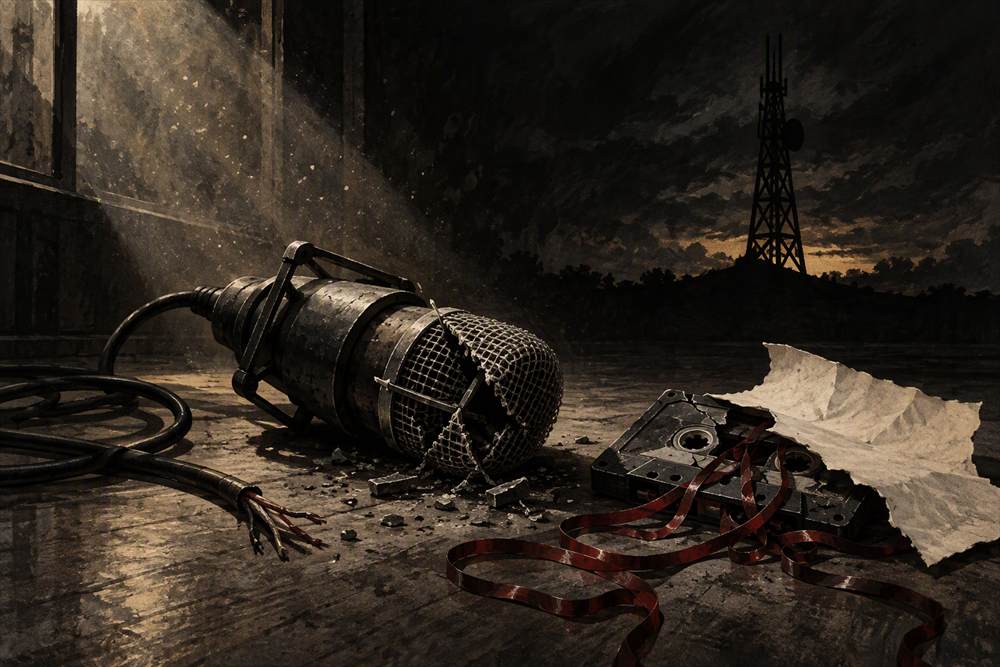
A smashed broadcast microphone, spilled cassette tape and a dark radio mast

After the border war with Ethiopia (1998–2000) that cost tens of thousands of lives, voices rose from inside the ruling front itself saying: enough. Fifteen leaders — ministers, field commanders and comrades-in-arms of the president himself — signed open letters demanding that the constitution be applied, elections held and those negligent in the war held accountable.

Isaias Afwerki's answer was to order, at dawn on 18 September 2001, the arrest of eleven of them, the closure of every independent newspaper at once — "Memitgnas", "Zemen", "Adaliss", "Setit" and others — and the arrest of their publishers and editors.

Since that day none of the detainees has been brought before a court, and no public charge has ever been issued against them. Rights reports placed a number of them as having died in custody, while the Swedish-Eritrean journalist Dawit Isaak has remained detained since 2001 without trial, in one of the longest cases of journalist detention in the world.

The outcome today: not one independent newspaper in the country, and Eritrea at the bottom of Reporters Without Borders' press-freedom index for years, behind even North Korea in some seasons. The word was silenced in a single day.. and the silence has gone on for a quarter of a century.

Sawa.. where lifetimes are stolen
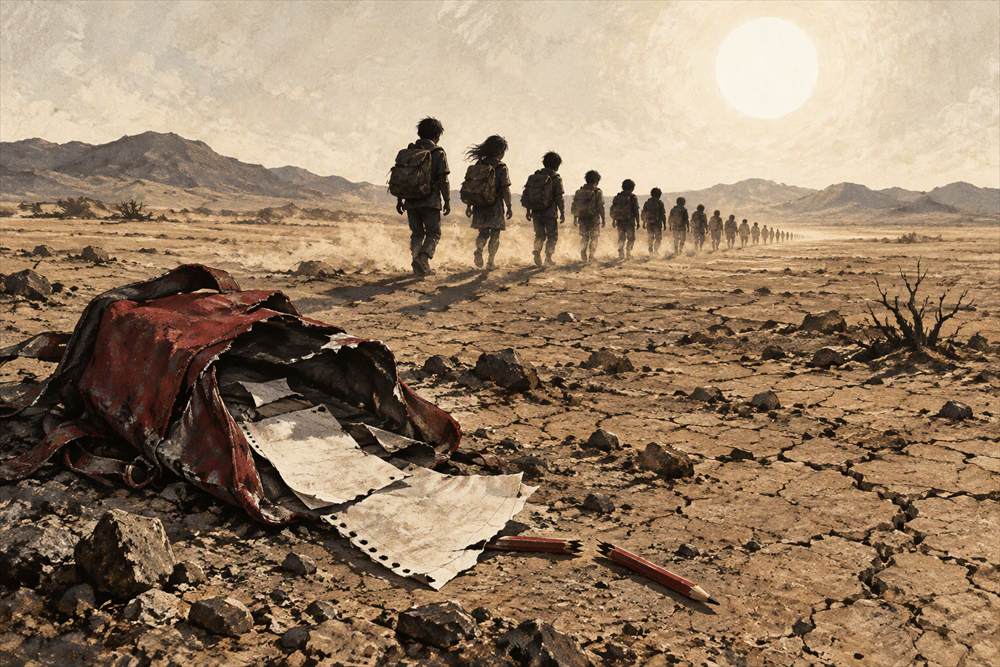
A line of young conscripts marching into a barren plain past a torn schoolbag

When national service was enacted in 1995 its length was eighteen months. But the 1998 war opened the door to turning it into open-ended conscription: an entire generation marched from the twelfth grade to the Sawa camp, and from there to the trenches, the farms or state projects, on symbolic wages that will not close a gap of hunger.

The UN Commission of Inquiry described this system as amounting to enslavement: open-ended forced labour under threat of prison and torture, in flat violation of international law.

And in the towns, raids take place that people call "Giffa": a security cordon around a neighbourhood or a market, and every young man without an exemption paper is taken in chains to the camps. As for those who try to cross the border, the United Nations documented orders to shoot at those who flee.

And so the homeland the young liberated became a prison guarded by the young themselves; no years for study, no years for marriage, no years for a dream.. the whole lifetime is a "national duty" that ends only in flight or in the grave.

The 1997 constitution.. the homeland never allowed to be born
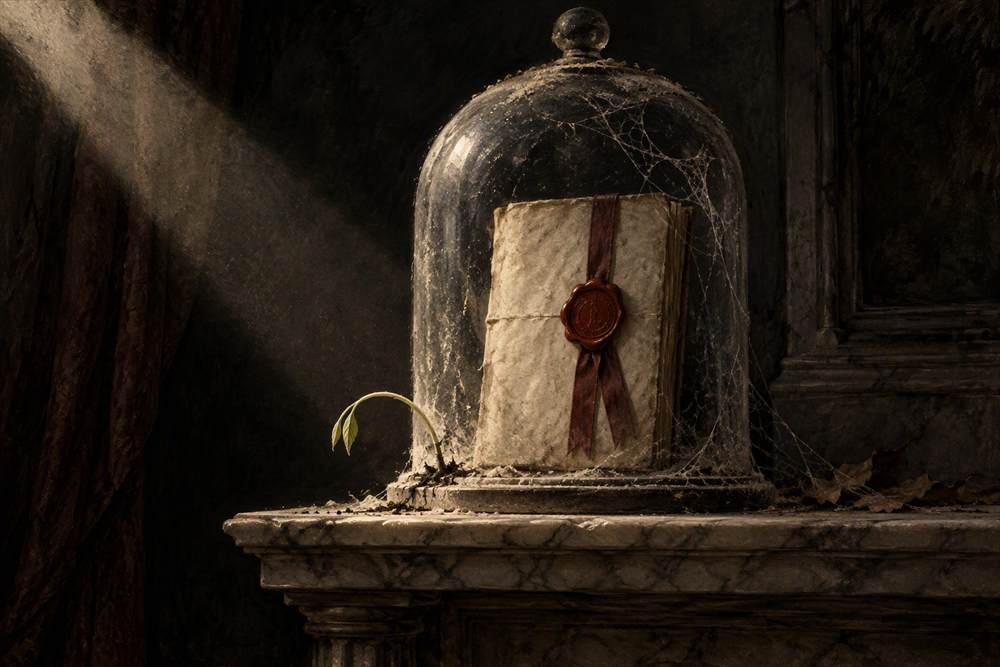
A sealed constitution gathering dust inside a glass dome, one sprout bent toward the light

In 1994 a constitutional commission was formed under the distinguished jurist Bereket Hapté Siassie, who travelled through the villages of Eritrea and its diaspora consulting the people, until the constitution was ratified in May 1997: party pluralism, separation of powers, periodic elections, a free press.

Not one article of it was applied. It was said that the 1998 war had "postponed" implementation, then that "the time was not right".. until the postponement itself became the country's actual constitution.

And today: no functioning parliament — the National Council has not met for years — no constitutional court, no party but the People's Front, and no president answerable to anyone. As for Bereket Hapté Siassie himself, the father of the constitution, he died in exile after watching his dream trampled.

A people who paid thirty years of blood for a homeland ruled by law now find themselves ruled by one man's mood. That is why we say: the battle of the constitution is not dead.. it is waiting for a generation to take it back.

The great exit.. a people voting with their feet
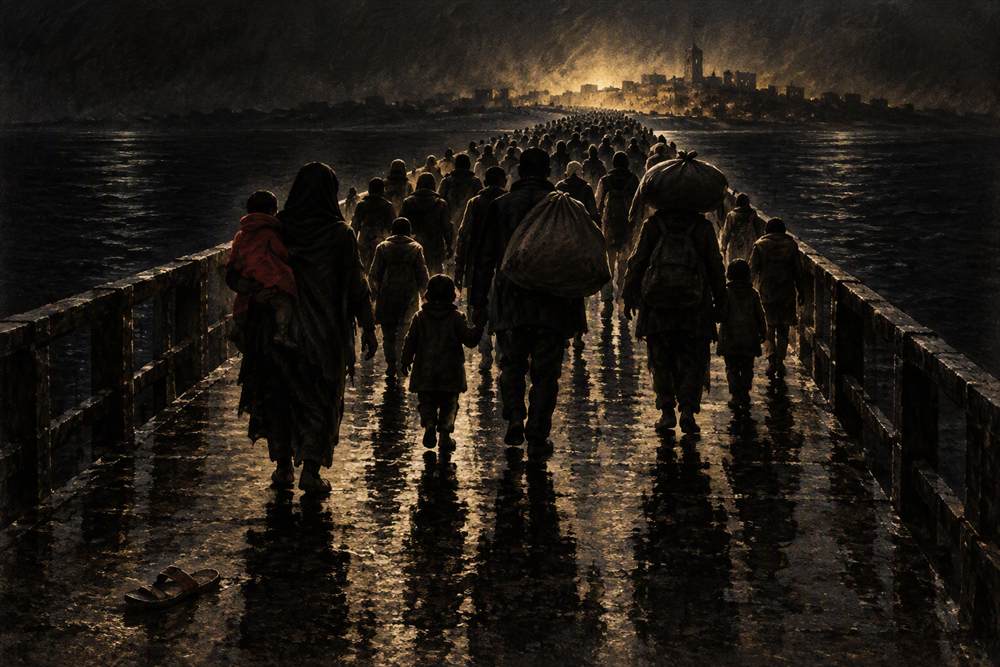
Silhouettes of families crossing a bridge at night toward a distant glow

No one needs an opinion poll to know how Eritreans judge their reality; it is enough to see the queues at the border. Hundreds of thousands fled over the past two decades, until Eritrea became one of the world's largest sources of refugees relative to population, and at the height of the crisis (2015) the United Nations estimated some five thousand departures a month.

And the road of flight is lined with death: the Sinai desert, where rights organisations documented human trafficking and torture for ransom, then the boats of the Mediterranean that swallowed thousands.

Instead of asking itself why its young are running, the system turned the tragedy into a revenue stream: a "2% tax" imposed on the children of the diaspora in exchange for consular services — a practice the UN Security Council condemned repeatedly.

Every boat that sinks and every young man wasting in a camp is a silent referendum on a quarter century of rule without a constitution. The people did not leave their homeland.. the homeland was temporarily expelled, and it will return.

Join us